How to start a business. Find your first customers.
A practical small business guide from idea to first sale. Validate demand, build a lean business plan, understand your startup costs and give the right people a reason to care.
Build your first-customer planHow do you start a business?
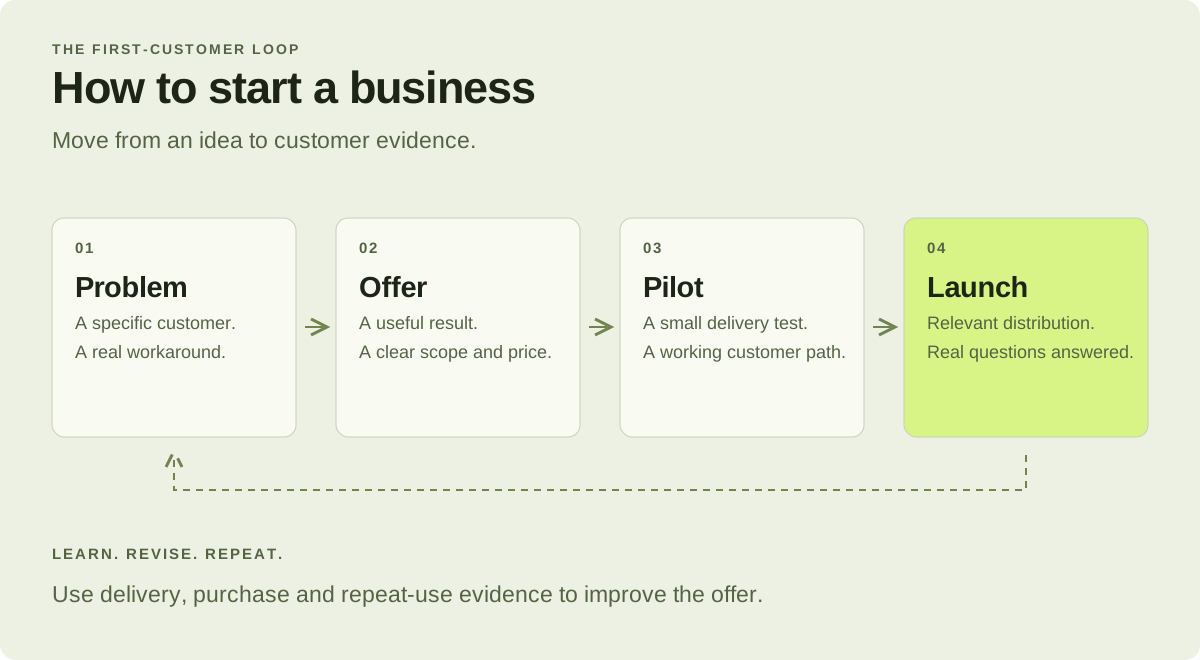
To start a business, choose a specific customer problem, validate demand, define a paid offer, estimate costs, complete the setup required for your location, and test a small launch. Your first milestone is evidence that a real customer wants the result and can receive it.

1. How do you choose a business idea worth testing?
Choose a customer, a recurring problem and a result you can deliver. Start with work you understand well enough to test in a small, practical way.
Starting a business becomes more manageable when the first version has a narrow job. “Software for small businesses” leaves almost every important decision open. “A tool that turns a freelance designer’s approved estimate into a client-ready project checklist” gives you a user, a trigger and an observable result.
Write down three problems you have seen people work around. For each, record who has it, what they use today, what an improvement would look like and how you could deliver a small version. Include the cost of changing habits. A better feature is not enough if adopting it takes more effort than the problem is worth.
| Model | First useful test | What to learn |
|---|---|---|
| Service business | A tightly scoped pilot for one customer | Can you deliver a repeatable result at a sustainable price? |
| Online software business | One working workflow for a specific user | Does someone complete the useful action and return? |
| Physical product | A sample, prototype or small batch | Do product quality, delivery and unit costs support the offer? |
| Digital product | A small paid resource with a clear use case | Does it solve the problem without extensive custom support? |
The most useful business idea is not necessarily the one with the biggest trend chart. It is one you can investigate, explain and deliver. Treat demand as a question to answer with customers before treating it as a reason to scale.
2. How do you validate demand before starting a business?
Combine market research with conversations and a concrete offer. Search interest shows curiosity; a relevant person taking a meaningful next step is stronger evidence for your specific business.
Read competing offers, customer reviews and public discussions. Save the language people use to describe the problem. Look for specific circumstances: an invoice that keeps going unpaid, a task that requires copying data between systems, or a purchase that repeatedly disappoints. These observations help you form a testable proposition.
In a customer conversation, ask about the last time the problem occurred. What happened? What did they do? Who approved the purchase? What made the existing solution hard to use? Asking “Would you buy my idea?” often produces politeness instead of a useful account of behavior.
Use a written evidence log: observation, source, date, what it suggests and what remains uncertain. Separate compliments from requests for a demo, pilot agreements and completed purchases. Each is evidence of a different level of commitment.
The SBA’s business planning resources provide a useful foundation for researching customers, competitors and startup costs. Use that broader research alongside direct observations of the people you intend to serve.
3. What should a simple business plan include?
A lean business plan should connect the customer, problem, offer, price, costs, acquisition method and evidence needed for the next decision.
Make the first business plan short enough to use during a real decision. A polished document cannot replace an unanswered question about who buys or how the work gets delivered. Write the assumptions plainly so a customer conversation can change them.
- Customer: the person in a specific situation, plus the person who pays if different.
- Problem: what happens today and why improving it matters.
- Offer: the promised result, included work and explicit boundaries.
- Economics: selling price, direct delivery costs, overhead and available cash.
- Distribution: how the first relevant people will hear about the offer.
- Decision: what evidence would justify continuing, revising or pausing the test.
Give every unknown an owner and a way to investigate it. “Customers will share this” becomes “Ask pilot customers what, if anything, they would send to a colleague, and observe whether they actually do.” The second version is more useful because it can be wrong in a way you can learn from.
The free business launch planner below turns your audience, offer and spending cap into an editable first-customer plan. It is a working starting point, not a substitute for industry-specific research.
4. How much money do you need to start a business?
There is no single startup budget. Estimate setup costs, recurring expenses, the cost of delivering each sale and a reserve using actual quotes for your business model and location.
List costs before choosing a funding strategy. A home-based service, an online store with inventory and a software product have different cash needs. Use supplier quotes and the fees relevant to your circumstances. Do not turn a generic “start for $100” headline into your operating budget.
| Cost category | What to include | How to estimate |
|---|---|---|
| One-time setup | Equipment, initial development, setup services | Obtain quotes and record which purchases can wait |
| Required setup | Applicable registration, permits, insurance and professional help | Check official requirements for your activity and location |
| Recurring overhead | Software, workspace, hosting and ongoing support | Record price, billing interval and cancellation terms |
| Cost per sale | Materials, processing, delivery and fulfillment labor | Measure a pilot from payment through delivery |
| Customer acquisition | Creative, outreach, creator fees or advertising | Set a small test budget and track the resulting customers |
| Reserve | Delays, refunds, replacement work and unexpected costs | Choose a buffer based on the risks you can identify |
Calculate contribution per sale as selling price minus the variable cost of providing that sale. If an illustrative $200 service takes $70 in direct delivery costs, it leaves $130 before fixed overhead, taxes and other expenses. That is not take-home income. Track cash timing as well: paying suppliers before customers pay you can strain an otherwise attractive model.
Set a validation spending cap and a review point. The goal is to learn whether your offer works before committing to a larger launch. Avoid spending the whole budget on a website while leaving no time or money to reach customers.
5. What business setup should you complete before selling?
Check the requirements for your location and activity, choose a usable name, establish how customers will pay and receive the product, and keep business records from the start.
A domain name and a business registration solve different problems. Check naming conflicts and relevant requirements before investing heavily in a brand. Make sure people can spell the name, understand the offer and reach a real contact. A memorable name cannot rescue a confusing service.
For a U.S. business, the appropriate structure, registrations, licenses, tax obligations and insurance depend on the activity and jurisdiction. Check the relevant government sources and use qualified help where needed. The SBA’s counseling network is a place to find small business assistance. This guide focuses on validation and customers; it does not select a legal or tax structure for you.
Before collecting money, make the customer’s path clear: the total price, what is included, when delivery happens, how to get support and the applicable cancellation or return terms. Test your payment and confirmation flow. Keep receipts and a record of what was promised.
6. What should your first business website say?
Your business website should tell the right visitor what you offer, show credible evidence, explain the next step and make important commercial details easy to find.
Build around the first question a potential customer asks. A useful headline names the result and the person it helps. A supporting sentence explains how it works or what makes the offer different. Then show the product, a permitted example or the actual process. Avoid presenting a mockup as a shipped feature or a fictional customer as a real testimonial.
A simple page can include the offer, demonstration, price or quotation process, scope, frequently asked questions and contact details. An unfamiliar visitor should not need to infer whether the next button buys something, books a call or joins a waitlist.
Test on mobile, with a fresh browser session and a person who did not help make it. Ask them what is being sold and what they expect after clicking. That exercise often reveals a better next revision than another round of decorative changes.
7. How do you get your first customers?
Start with reachable people who have the problem. Use relevant introductions, thoughtful outreach, helpful public demonstrations and small partnerships to test the offer.
Build a prospect list around fit, not its length. Record why each person could benefit, how you know that and which communication channel is appropriate. Warm introductions are useful when the introducer understands the problem. A relevant public discussion can also create an opening to contribute an example without turning every reply into a pitch.
Make outreach specific and easy to decline. Reference the actual situation, offer one useful thing and ask for a small next step. Do not imply a relationship that does not exist or send identical messages to everyone in a community.
Choose a distribution method that fits how the buyer learns. Local services may benefit from local relationships and relevant listings. A developer tool can benefit from a working example and technical explanation. A visual product may need a demonstration. Our influencer marketing guide explains when creators are a useful way to introduce an offer to a relevant audience.
Give the first customer a reliable experience. Deliver the agreed work, ask what remained difficult and request permission before using their story publicly. Learning how someone succeeds after buying is part of finding a repeatable acquisition method.
8. How do you launch a new business online?
Launch one clear offer with a working destination, a visible demonstration, a small distribution plan and someone ready to answer real questions.
Separate the announcement from the preparation. Prepare a concise explanation, a useful visual, the live destination and a list of people expecting the update. Confirm that the product, payment and support flow work. Make the announcement when someone can respond to questions and fix problems.
For a launch on X, keep one anchor post with a permanent URL. Share it with relevant people who expected to hear from you, explain the product in replies and let supporting creators contribute their own useful perspectives. Bring newsletter or community readers into the conversation when that is appropriate for the channel.
The Xpickr launch-day field manual covers the detailed coordination. If you want the team to coordinate promotion, see the launch service and current pricing. Buying distribution is a later decision; it does not replace validating the offer.
If a giveaway is relevant to your audience, make eligibility and selection clear. Xpickr’s X giveaway picker, YouTube picker and TikTok picker are tools for that particular job. A giveaway entry is not automatically a qualified customer or permission for a sales sequence.
9. What should you measure after your first launch?
Measure the whole customer journey: relevant interest, completed purchases or trials, successful delivery, repeat use and the cost of getting those outcomes.
Keep a small decision dashboard. Record the source of visits where observable, qualified inquiries, completed purchases, delivery time, direct costs and refunds. For software, include activation and return use. A rising view count can be encouraging, but it cannot tell you whether the business is delivering value.
Diagnose the point of friction. Visits without inquiries suggest an offer, audience or destination issue. Inquiries without purchases can point to scope, price or trust. Purchases with poor delivery suggest an operations problem. More promotion magnifies the current journey, including the parts that are breaking.
Keep the next experiment specific. Change the opening explanation, simplify one onboarding step or test one new audience. Record the change and the result. You are building a business process that gets clearer with evidence, not trying to validate every assumption with a single launch.
Your first-customer plan, on one page.
Describe your business idea. Get a practical starting plan you can edit, copy and use. Runs in your browser; these inputs are not submitted to Xpickr.
Example plan — edit the fields to make it yours
Starting a business: frequently asked questions
How do I start a business with no money?
Start by investigating a service or other offer you can deliver with skills and resources you already have. Interview potential customers and test a small scope before buying tools or inventory. No-money validation does not mean every business can legally operate or fulfill orders without costs.
How do I start an online business?
Choose a specific audience and problem, validate the offer, prepare the required business setup, make one useful product or service available, and build a working payment and delivery path. Then use a small acquisition test to learn who buys and whether the offer delivers its promised result.
Do I need a business plan before launching?
A lean plan helps connect your customer, offer, costs and distribution assumptions. Some financing or other situations may require a more formal plan. For an early test, keep a working decision sheet and update it as you learn.
Should I build a website before finding customers?
You can research a problem and show a simple demonstration before building a full website. Have a clear, trustworthy destination and the required setup in place before asking people to buy. Build enough to support the next meaningful customer action.
How long does it take to start a business?
It depends on the product, required setup, location, supply chain and sales process. Separate the time to test an idea from the time to operate a fully functioning business. Use milestones such as a tested offer, completed setup and a successfully delivered pilot.
When should a new business pay for marketing?
Consider a small paid distribution test when the offer is understandable, the customer journey works and you can measure a useful outcome. Keep enough budget to learn and improve. Paid reach does not guarantee sales or replace product-market learning.
Sources and editorial notes
This is Xpickr’s original planning guide. Examples and calculator defaults are illustrative. Primary sources below support the referenced requirements and research; the planning frameworks and worksheets are our own. Reviewed November 15, 2026.
- SBA: plan your business ↗Official U.S. resources for market research, business planning and startup costs.
- SBA: business counseling ↗Small business assistance and links to local advisers.
Questions or corrections: info@thexpicker.com.