Influencer marketing. Make the right people care.
How influencer marketing works, what a campaign really costs, when to use organic or paid distribution, and how to run a creator-led product launch on X and other social platforms.
Plan your campaign budgetWhat is influencer marketing?
Influencer marketing is a collaboration in which a brand works with a creator to introduce or explain a product to a relevant audience. A useful campaign connects audience fit, credible product proof, clear deliverables and a working customer journey. Sponsored creator posts, platform ads and earned recommendations are different forms of distribution.

1. What is influencer marketing and how does it work?
Influencer marketing connects a brand with a creator whose audience has a reason to care about the product. The creator contributes an explanation, demonstration or perspective that helps people evaluate it.
A useful creator partnership transfers context, not just attention. The audience already understands what the creator talks about and how they evaluate things. Your product enters that existing conversation. A technical walkthrough, a founder’s informed reaction and a customer’s approved use case can each introduce the same release from a different angle.
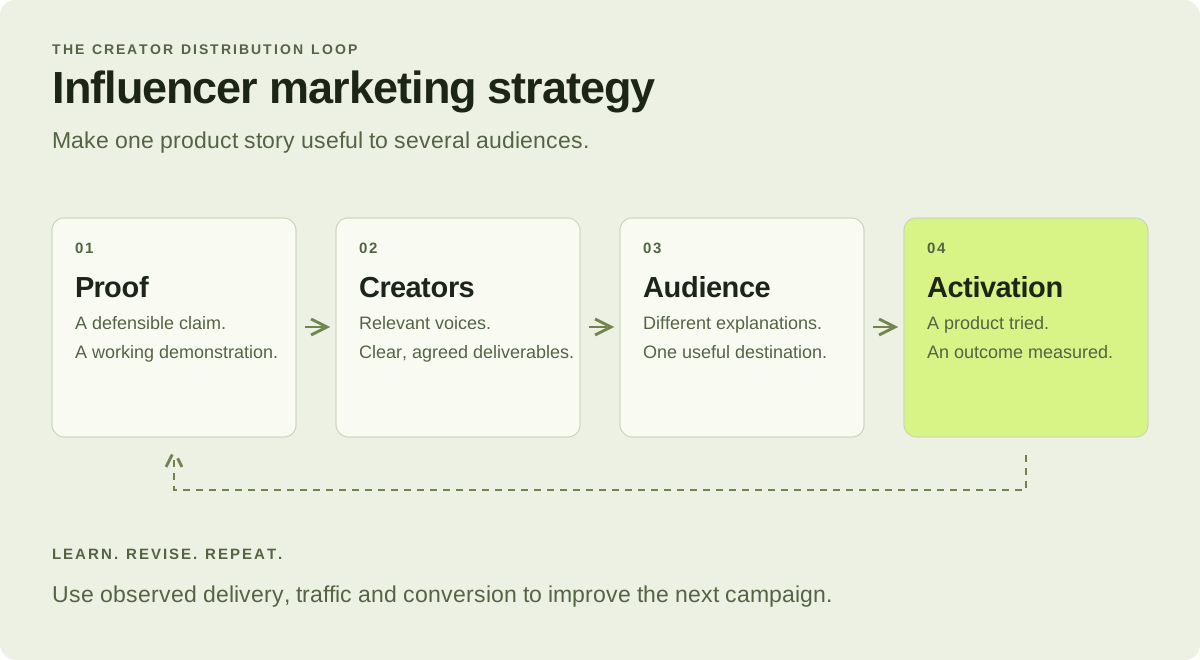
For a product launch, the practical chain is: show credible proof, choose relevant creators, agree useful contributions, prepare a working destination and measure what happens after publication. If any link is weak, a bigger lineup may create more exposure without a better result.
A creator can be relevant with a relatively small audience. Reach, topic fit, audience location, typical viewing behavior and the quality of discussion all matter. A follower count describes one property of an account; it does not establish how many suitable buyers will see a particular post.
2. Organic vs paid marketing: which should a launch use?
Owned organic posts, earned recommendations, sponsored creator content and platform ads serve different jobs. Choose based on audience access, creative needs, budget and the outcome you can measure.
| Approach | What you control | Useful when | Main tradeoff |
|---|---|---|---|
| Owned organic content | Your account, explanation and publishing process | You have something useful to demonstrate and can sustain conversation | Audience access and distribution are uncertain |
| Earned mentions | Product access and information you offer | Someone has an independent reason to discuss the product | You cannot require coverage, timing or a favorable view |
| Sponsored creators | Agreed deliverables, factual brief and commercial terms | Relevant creators can explain the product to their audiences | Requires screening, coordination and appropriate disclosure |
| Platform advertising | Targeting options, creative, bids and spend settings | You have creative and a conversion path ready for testing | Costs money to learn; reported attribution has limits |
A post can appear in a normal feed and still be paid marketing. If a creator is compensated, describe the arrangement accurately. Do not relabel a sponsored introduction as an independent recommendation just because the format resembles an ordinary post.
Use organic material to learn which explanation people understand. Use creator partnerships when another person can add a relevant demonstration or point of view. Use ads when you have a suitable asset, destination and a defined spend test. A launch can combine them, but each budget line and outcome should remain identifiable.
A practical first question is “Where are the people who need this already paying attention?” The answer should determine the channel. Do not buy a large audience first and search for a connection to your product afterward.
3. How do you build an influencer marketing strategy?
Define one audience, one product claim, one primary action and the evidence needed to support the claim. Choose creators and formats around that decision.
Start with a campaign decision sheet: the buyer, the launch trigger, the product change, the proof artifact, the destination and the primary outcome. “Generate awareness” is too open-ended to guide creator selection. “Help engineering leads try the new debugging workflow” gives the campaign a concrete job.
Map several ways to explain the release. One creator may be strongest at a live demonstration; another may teach the category; another may reach the people approving a purchase. Diversifying those perspectives can be more useful than recruiting several accounts that all repeat the same audience and message.
Write down what the campaign must not imply. Examples include unsupported benchmark superiority, a customer relationship that does not exist, features not yet available or guaranteed income. Give creators access to the product and the evidence so they can decide what they can honestly explain.
For the detailed publication sequence, use the Xpickr product launch playbook. If you are still deciding what to offer, begin with validating business demand before booking distribution.
4. How do you choose the right influencers or creators?
Review audience fit, recent comparable content, typical performance, geographic relevance, discussion quality and the creator’s ability to understand the product.
Read a reasonable set of recent comparable posts rather than selecting from one exceptional hit. Note format, topic, age of the post and visible responses. A recent product walkthrough and an old entertainment post are different reference points. Ask for relevant first-party audience or performance information where available, and keep its measurement date.
| Screening area | What to inspect | Decision question |
|---|---|---|
| Topic fit | Recent explanations and discussions | Would this audience understand why the product matters? |
| Audience geography | Dated audience information and language | Can the people reached use or buy the product? |
| Typical performance | A set of comparable posts, not a single peak | What does an ordinary relevant post look like? |
| Credibility | Product understanding and substantive responses | Can this person contribute a useful, truthful perspective? |
| Audience overlap | Shared communities and recurring participants | Does another creator add a new group or a useful reinforcement? |
| Operational fit | Availability, approvals and reporting | Can the agreed work actually happen within the launch plan? |
Use a simple shortlist with a written reason for each account. Keep sample links, open questions, proposed format and commercial status together. Screening is a decision process, not a claim that you can conclusively prove every follower is human.
Agree the evidence of delivery in advance: a public URL, agreed format and the reporting the creator can provide. Keep the expected work separate from an estimated reach number. A promise to publish is a deliverable; a predicted view count is an assumption unless a specific commercial guarantee says otherwise.
5. How much does influencer marketing cost?
The total cost can include creator fees, production, usage rights, management, paid media and a contingency reserve. A creator’s quoted post rate is only one part of a campaign budget.
Request quotes against a specific scope: platform, content format, publication window, revisions, reporting, content reuse, paid advertising rights and any exclusivity. Two prices are not comparable if one includes a posted video and the other includes only a video file.
Distinguish content production from distribution. A user-generated content asset may be delivered for the brand to publish, with no post to the creator’s audience. A sponsored creator post includes a publication obligation. Permission to run it as an ad or reuse it elsewhere needs its own agreed terms.
Collabstr’s 2026 marketplace report uses first-party collaboration data. It is useful context, but its marketplace and platform mix do not establish a standard rate for every technical creator, X campaign or managed launch. Get quotes for the actual work you need.
The influencer marketing budget calculator keeps those line items separate and shows the arithmetic. You can also model cost per click and cost per conversion using your own traffic assumptions. The calculator does not predict how much reach or revenue a campaign will generate.
Xpickr’s managed launch offers currently start at $79 one time, with $499.99/month and $4,999.99/month options. Those are service prices, not per-creator market benchmarks. Check the service page for the current offer and billing terms.
6. What should an influencer campaign brief contain?
A useful creator brief states the audience, product change, evidence, agreed contribution, destination, timing, factual boundaries, disclosure and approval process.
Give the creator enough context to form a real view. Include product access, a short explanation, an approved fact sheet and the person who can answer technical questions. Explain the job of the contribution rather than writing identical praise for every account.
Choose which approvals are necessary. Factual accuracy, launch timing, rights and required disclosures are legitimate coordination needs. The brief should preserve the creator’s own explanation and should not require a fabricated personal experience.
Keep the final asset version and live post URL with the brief. A scattered message history becomes hard to audit when a launch changes time or someone uses an old file. The tool below includes an editable brief you can copy without creating an account.
7. How do you run influencer marketing for a product launch on X?
Prepare the anchor announcement and working product journey, confirm creator contributions, publish the live reference, answer questions and follow through with useful new material.
| Stage | Action | Evidence to keep |
|---|---|---|
| Before launch | Confirm product access, brief, scope, asset and timezone | Approved facts and acknowledged deliverables |
| Rehearsal | Test the post, demo, mobile destination and signup path | Working links and an owner for fixes |
| Publication | Verify the anchor is public before sharing its URL | Permanent announcement and creator post links |
| Conversation | Answer real questions and add relevant explanations | Questions, misunderstandings and support issues |
| Follow-through | Publish a useful deeper example and resolve open requests | Delivery report and observed conversion events |
Use windows that fit the audience and the people doing the work. An exact minute, a country mix or a ratio of likes to reposts is not a reliable formula for virality. Prepare material that earns genuine interest rather than purchasing artificial metrics or scripting a false consensus.
Link to the anchor from appropriate owned channels, such as a product update, newsletter or video description, when the discussion itself is useful. Measure those outbound clicks separately from visits returning to the product. Sending people into X and receiving traffic from X are different legs of the journey.
The must-read launch-day field manual supplies a more detailed coordination template. For fulfillment by our team, Xpickr’s launch service takes payment and a tweet or upcoming launch brief, then coordinates the campaign. The public service page is the source for current pricing.
8. How do you measure influencer marketing ROI?
Report delivery, exposure, traffic, conversion and campaign cost separately. Calculate return only from clearly defined, attributable business outcomes and disclose the limits of the measurement.
Start with what you can observe. Confirm that contracted posts were published. Capture reported views at consistent ages. Use campaign-tagged links where appropriate and verify that the tags survive redirects. Record a meaningful product action, not merely the loading of a signup page.
- Cost per click: campaign cost divided by observed attributable clicks.
- Cost per acquired customer: campaign cost divided by attributable new customers, using a stated acquisition definition.
- Campaign ROI: attributable contribution profit minus campaign cost, divided by campaign cost. State how you allocated costs and profit.
Do not label a signup as a customer or revenue as profit. Adding views across several posts produces summed post views, not unique reach. A person may encounter multiple creators, return directly or buy later on another device. Attribution is partial; explain which outcomes were directly observed and which remain uncertain.
Use weak results to identify a problem. Exposure without clicks calls for reviewing relevance and the next step. Clicks without activation call for reviewing the product journey. A small campaign can produce useful learning even when it does not justify expanding spend.
9. What mistakes should influencer marketing campaigns avoid?
Avoid selecting by follower count alone, buying unclear deliverables, hiding sponsorship, exaggerating results, skipping the customer journey and treating every view as a potential sale.
Check disclosure before publication. The FTC’s disclosure guidance explains that material relationships should be made clear with the endorsement. Money is not the only relevant connection; gifted products and other benefits can matter. Review the rules applicable to the campaign and its audience.
On X, review the paid partnerships policy for platform requirements. A platform label and a general disclosure obligation are related considerations; do not assume a bio-only statement explains the relationship on every post.
Before spending more, ask whether a stranger can understand the product, whether the creator can demonstrate it credibly and whether the visitor can complete the intended action. Those checks improve the campaign you actually control. A promise of guaranteed virality does not.
Keep the reusable work: screening notes, approved facts, final briefs, live links and the review. The second campaign should start with evidence from the first. If you are building the offer itself, return to the guide to starting a business and finding your first customers.
Know your campaign cost before you commit.
Build an influencer marketing budget from your own quotes and assumptions. Default numbers are illustrative, not market rates or an Xpickr quote. Taxes and costs you have not entered are excluded.
- Creator fees
- $750.00
- Other entered costs
- $450.00
- Reserve
- $120.00
Scenario, not a forecast
- Modeled conversions
- 12.00
- Cost per click
- $4.40
- Cost per conversion
- $110.00
Conversions use the goal you choose, such as signups. They are not automatically paying customers. A dash means the denominator is zero.
View the copyable calculation
INFLUENCER CAMPAIGN BUDGET (USD)
Creator fees: $750.00
Production: $200.00
Rights: $100.00
Management: $150.00
Paid media: $0.00
Subtotal: $1,200.00
Reserve: $120.00
Planned total: $1,320.00

SCENARIO, NOT A FORECAST
Assumed clicks: 300
Assumed conversion rate: 4%
Modeled conversions: 12.00
Cost per click: $4.40
Cost per conversion: $110.00
Based only on the inputs entered. No reach, conversion or revenue is guaranteed.
Your editable creator brief
Influencer marketing: frequently asked questions
Is influencer marketing paid or organic?
It can involve different arrangements. A compensated creator collaboration is sponsored marketing even when it appears as a normal feed post. An unsolicited recommendation without a brand relationship is earned coverage. The brand’s own unpaid posts are owned organic content.
What is the difference between influencer marketing and UGC?
A creator may produce user-generated-style content for a brand to publish without posting to their own audience. Influencer distribution includes an agreed audience-facing publication. Confirm production, publication, reuse and paid advertising rights separately.
How much should a startup spend on influencer marketing?
Start from the work needed and the amount you can afford to test. Request scope-matched quotes, include production, rights and coordination, and keep a reserve. There is no universal startup budget or guaranteed spend-to-revenue ratio.
Are micro-influencers better than large influencers?
Neither is automatically better. Compare audience relevance, typical comparable content, credibility, format and the cost of the agreed work. A small relevant audience can be useful, but audience size alone does not predict campaign results.
Can influencer marketing help a B2B or AI startup?
Yes, when creators reach the people evaluating the problem and can explain the product credibly. A technical demo, integration walkthrough or workflow comparison may fit better than a generic endorsement. Measure qualified product interest and activation as well as exposure.
Can creators guarantee that a launch will go viral?
A creator can commit to specified work and reporting. Recommendation systems, audience response and commercial outcomes remain uncertain. Treat view forecasts as estimates and inspect any actual guarantee and its conditions before relying on it.
Sources and editorial notes
This is Xpickr’s original planning guide. Examples and calculator defaults are illustrative. Primary sources below support the referenced requirements and research; the planning frameworks and worksheets are our own. Reviewed November 15, 2026.
- FTC: Disclosures 101 for social media influencers ↗Primary U.S. guidance on material connections and clear endorsement disclosures.
- X: paid partnerships policy ↗Platform requirements for compensated creator promotion.
- Collabstr: 2026 influencer marketing report ↗First-party marketplace research; the sample is not a universal rate card.
Questions or corrections: info@thexpicker.com.